
In the previous article, I briefly introduced the EDI — Evangelistic Difficulty Index, a numerical measure designed to express how difficult it is to evangelize a particular region.
To recap, the index combines three factors: missionary scarcity, material resource scarcity, and religious intolerance.
Why were these three criteria chosen?
Because missionaries, material resources, and religious freedom are among the primary resources available for advancing the Gospel in any region. The more abundant these resources are, the easier missionary work tends to become. The EDI, therefore, is essentially a measure of the scarcity of evangelistic resources in a specific place at a specific point in time.
A few important observations should be made.
1 – Since the EDI represents a single location at a particular moment in time, it does not necessarily capture the historical progress of evangelism.
In other words, the EDI does not directly tell us whether a region has already been thoroughly evangelized. Rather, it provides important clues.
Consider the case of the Dominican Republic:
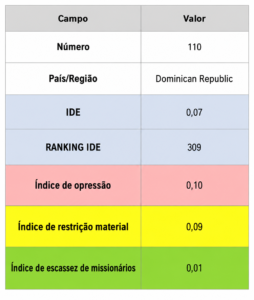
Among the 310 regions included in the EDI, the Dominican Republic ranks as the 309th easiest region to evangelize because it has a large missionary presence, relatively few material restrictions, and broad religious freedom. Does that mean the Dominican Republic has already been evangelized? The EDI does not answer that question directly. Instead, it raises another question: If a region already has abundant missionaries (who themselves are the result of previous evangelistic work), sufficient material resources, and very few restrictions on religious liberty, isn’t it reasonable to conclude that the missionary task there is already highly advanced—or perhaps even nearing completion? This leads to a second important observation.
2 – Although the EDI is not a direct measure of evangelistic progress, it clearly identifies the regions about which we need to be less concerned. A low EDI indicates that the evangelistic resources already present in that region are sufficient—or more than sufficient—to complete the work there. A healthy evangelistic dynamic is already established. It does not require additional reinforcement. Ellen White wrote:
“”The money expended in enlarging the institutions at Battle Creek might better be used in planting the truth in cities and places where it has not yet taken hold. Money has been entrusted to human agents to be invested in the Lord’s work, distributed to the exchangers, and increased by use. Again and again men in positions of trust have had placed before them the necessity of having the Lord’s vineyard more equally worked. The vineyard is the world, every part of it belongs to the Lord and should receive due attention. No one locality should absorb all the means that can be obtained to enrich, enlarge, and multiply its facilities while the larger portions of the field are left destitute. This policy is not inspired by God. Gracious calls of mercy are to be given to every part of the world. God’s field is the world.”
Spalding and Magan Collection, p. 13
If the Lord’s vineyard is to be cultivated more evenly, the very least we can do is stop directing additional resources toward places where a strong evangelistic momentum already exists.
The real question is not whether the Dominican Republic needs more resources, but rather how many of its existing resources could instead be directed toward regions with far greater evangelistic challenges.
Naturally, many evangelistic resources already tend to remain where they are.
Financial resources often cannot easily leave a country.
Likewise, many missionaries neither wish nor ought to leave their own homeland.
Even so, deliberately increasing evangelistic efforts in places with a low EDI does not appear to reflect God’s broader missionary priorities.
If anyone doubts that this happens, one need only look at the Caleb Mission Project.
To illustrate, consider a common example. A group of young Seventh-day Adventists from southern Brazil—say, from the Central Paraná Conference—travels to the neighboring state of Mato Grosso do Sul for evangelistic work.
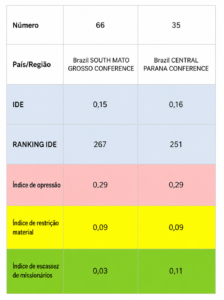
Both regions enjoy essentially the same level of religious freedom and similar access to material resources. However, Central Paraná is actually slightly more lacking in missionaries than Mato Grosso do Sul. This brings to mind another statement from Ellen White:
“There are those who think they have a duty to preach the truth, yet they do not venture away from the shore, and therefore catch no fish. They prefer to remain among the churches, continually covering the same ground. They report good meetings and pleasant visits, but we wait in vain for souls to be converted through their efforts. These ministers sail too close to shore. Let them launch out into the deep and cast their nets where the fish are. There is no lack of work to be done. Hundreds could be employed in the Lord’s vineyard where now there is but one.”
The True Missionary, fevereiro de 1874
Young people who leave Paraná to evangelize Mato Grosso do Sul temporarily increase the number of missionaries in a place that already has more missionaries per capita than the region they came from. In effect, they reduce the evangelistic strength of the place that needs them more in order to reinforce a place that needs them less. Those young Adventists are actually more needed in Central Paraná than in Mato Grosso do Sul. Ellen White warned against remaining near the shore instead of launching into deep water. Yet this type of missionary movement can become something even less strategic: rather than moving toward deeper waters, those already standing on the shore simply walk farther inland. It is like walking deeper into the mangroves to catch crabs instead of sailing out to sea to catch fish. This leads to one final observation.
3 – Ellen White’s illustration of the shoreline and the open sea provides an excellent picture of what the EDI seeks to represent. The higher the EDI, the farther offshore the mission field lies. The lower the EDI, the closer it is to the beach. If the Lord’s vineyard truly is the whole world, then an EDI between 0.00 and 0.30 may reasonably be considered “the shoreline.” This range includes every region of Brazil (with Piauí, at 0.25, being the country’s highest score), the rest of South America, Canada (0.17), the United States (0.18–0.23), all of Central America, much of Africa, and a considerable portion of Europe. Above 0.30, we begin stepping into the water. Examples include Bulgaria (0.31) and Timor-Leste (0.33). At 0.40, the water is already over our heads. Examples include Senegal (0.40) and Cambodia (0.40). Beyond that, the waves become increasingly intimidating. Thailand (0.44) and Vietnam (0.45). Above 0.50, the journey requires a boat. Bangladesh (0.54) and Tunisia (0.57). At 0.60, the shoreline has disappeared from view. Turkey (0.60) and Pakistan (0.61). And farther still, beyond the visible horizon, lies a storm of extraordinary magnitude. Syria (0.80). At that point, “fear” may no longer be the right word. Perhaps desperation better captures the challenge.
The EDI does not necessarily mean that every one of us should go to Syria—although that would not be an unreasonable calling for some. It simply suggests that, wherever we are, perhaps we should all be willing to swim a little farther from shore.
“Launch out into the deep, and let down your nets for a catch.”
Luke 5:4
May God bless you all.
Lucas
