
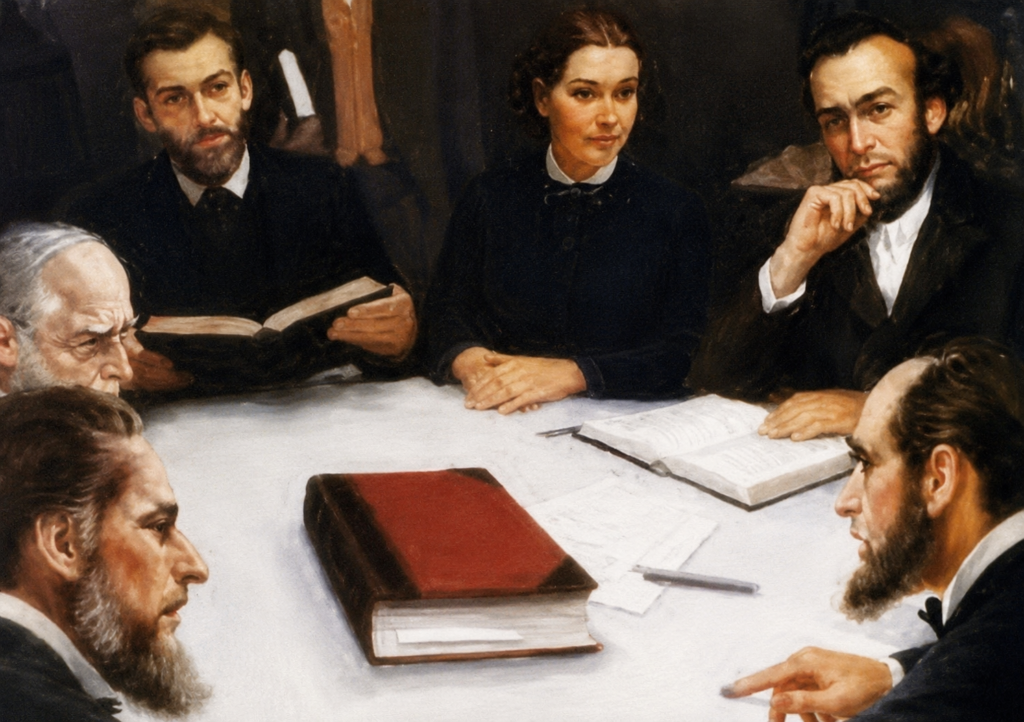
“Social gatherings may be made highly profitable and instructive when those who come together have the love of God burning in their hearts, when they meet to exchange thoughts concerning the Word of God, or to consider methods for advancing His work and doing good to their fellow men.”
Testimonies to Ministers and Gospel Workers, p. 82
First of all, I want to make it clear that the appeal I am about to make is not directed merely to the Seventh-day Adventist whose faith consists only of attending church on Saturdays.
Rather, this brief article is primarily addressed to the Adventist who embraces Present Truth—one who recognizes the need for every aspect of Christian character reform, understands the message of country living, is fully convinced that victory over sin is possible through Jesus Christ, and has overcome any hesitation about directing tithes and offerings toward evangelistic projects that are genuinely fulfilling the Great Commission.
With that in mind, let us consider this passage from Testimonies to Ministers, which outlines several conditions under which social gatherings among Christians become truly beneficial and instructive:
Is there any doubt that God’s people have His love burning in their hearts? Is there any doubt that, when they gather together, they exchange valuable insights about God’s Word and seek to bless those around them? Surely the answer to both questions is no.
But when God’s people gather—even informally—do they spend any time discussing practical ways to advance God’s work? Do they actually talk about questions such as:
“The Lord desires to break up the settled routine that has become so firmly established, for it has hindered rather than advanced His work. He desires His people to remember that there is a vast territory upon which the light of present truth is yet to shine.
Divine wisdom must be given ample room to work. We are to move forward without waiting for the permission or support of those who have assumed authority for themselves. In the past, a group of men sought to keep under their own control all the funds received from the churches. They used those resources in a highly disproportionate manner, erecting expensive buildings where they were unnecessary while leaving needy fields without help or encouragement.
They assumed the grave responsibility of delaying the work in places where it should have been advancing. It was left to a few supposedly wise men to decide which fields should be entered and which should remain untouched.
Some confined the truth to limited channels because opening new fields required financial resources. They were willing to invest only in places that interested them. At the same time, in certain locations, five times the necessary amount was spent on buildings.
The very same amount of money invested in establishing mission centers where the truth had never before been introduced would have brought many souls to a saving knowledge of Christ.”
Spalding and Magan Collection, p.174,175
Someone might rightly say, “This passage is referring to poor leadership, not good leadership.”
That is true. Even so, what are the chances that even a capable leader will eventually fall into repeated cycles of poor decisions if those under his leadership cease to cultivate an environment where good, holy, and Christ-centered ideas can flourish?
Notice that “it was left to a few supposedly wise men to decide which fields should be entered and which should remain untouched.” This reveals a clear spirit of passivity.
If a leader has no ideas to draw upon except his own, then naturally his only option is to rely on himself—and sooner or later, he will likely make mistakes.
Someone else may argue—incorrectly—that a leader needs nothing more than direct instruction from God.
Yet Ellen White writes of the counsel Jethro gave to Moses when he had become overwhelmed by judging the people of Israel alone:
Patriarchs and Prophets, p.301
This story vividly illustrates the burden a leader may bear when surrounded by an environment barren of ideas. Guided only by his own thinking, sooner or later he is bound to stumble.
In fact, I have probably been rather restrained in arguing for the importance of continually exchanging ideas and making plans together as fellow believers. Ellen White was far more direct. She warned that when believers fail to counsel together, they create an opportunity for Satan himself.
Testimonies for the Church, vol. 5, pp. 29–30.
May God’s people not merely accept that social gatherings should include more conversation about methods for advancing His work, but also examine the reasons they may remain silent about evangelism—if indeed that is the case. Is it because of shyness? Fear? Reluctance? A contentious spirit? Strong personal agendas? Positions that no one is willing to reconsider?
Sooner or later, we must become intellectually and spiritually convinced that discussing the practical aspects of evangelism is not only appropriate but a healthy and essential part of Christian fellowship.
The Desire of Ages, p. 361.

Support the Mission
Pix Key (Business Tax ID)