

Hello!
Over the past week, I have been working on an idea that has been on my mind ever since my wife, Vanessa, and I began collecting quotations for Evangelhopolis. Among Ellen White’s many counsels, one passage in particular has continued to challenge me:
“”In this work all the churches that have been established are to act a part according to their several abilities. If difficulties arise in the missionary fields, let interested investigation be made without delay, that the path of duty may not be hidden or obscured. As these questions are brought before those who are wise in the wisdom of God, investigation will be united with the exercise of prudence. By using the knowledge God has given them, men will gain a clear and distinct experience. As they exercise their God-given ability in helping to plant the standard of truth in new territory, they will receive great blessing. After they have sought unselfishly to gain a correct understanding of the situation, let them approach the mercy seat, asking for clear discernment and an unselfish purpose, that they may see the needs of distant fields. As they ask the Lord to help them advance the work in regions beyond, grace from above will be given them. They will never seek the Lord in vain.”
The Kress Collection, p.117
As we gathered statements from the Spirit of Prophecy on evangelism, one thing quickly became evident: Ellen White consistently describes an approach to evangelism that is deeply spiritual, yet never detached from reality. It is not guided by emotion or vague impressions about where work should be done, but by a sincere effort to understand the actual conditions of each mission field, whether near or far.
There is no need here to revisit every appeal Ellen White made for rational, thoughtful faith. Her call for careful, well-informed evangelistic work is simply another expression of that same principle.
This led me to ask a question: if the counsels are so clear about pursuing evangelism that is fervent, intentional, informed, and thoughtful, why have Seventh-day Adventists often embraced a more instinctive approach—one that seems to send missionaries in every direction without clear criteria or strategic guidance?
Based on the research Vanessa and I conducted, the primary reason appears to be the dominance of what we describe in Evangelhopolis as goal-driven evangelism with shifting targets.
Once that became clear, another question naturally followed: what should biblical evangelism, guided by rational faith rather than vague impressions, actually look like?
n Chapter 7 of Evangelhopolis, we examine several biblical principles alongside Ellen White’s writings, all of which can essentially be summarized by the quotation above: through both prayer and careful study, we should seek a clearer understanding of the missionary needs before us—whether in our own communities or around the world.
That reflection led me to consider the importance of developing meaningful indicators for evangelism—indicators that are clear, practical, and capable of reflecting realities that truly matter.
Such indicators should help us understand issues such as the current progress of evangelism and whether a particular region has an abundance or shortage of missionary resources.
As I began organizing these ideas into a spreadsheet over the past week, the result became what I have called the EDI — Evangelistic Difficulty Index (only later did I realize how well the initials fit the name).
The complete spreadsheet and the data sources used in this project are attached at the end of this article.
In summary, the EDI is an index designed to estimate the actual difficulty of proclaiming the Three Angels’ Messages in a particular region of the world, whether that region is an entire country or a smaller administrative area within one.
The current version evaluates 310 regions worldwide, including 54 regions in Brazil, the country with the world’s largest Seventh-day Adventist membership.
An Example: Vietnam
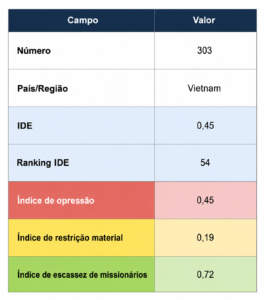
Vietnam has an EDI score of 0.45, making it the 54th most difficult country or region for evangelism among the 310 regions evaluated.
Where does that 0.45 come from?
The calculation is simply:
(Oppression Index + Material Restriction Index + Missionary Scarcity Index) ÷ 3
Components of the EDI
Oppression Index
This index is built from two measures of religious freedom published by the Pew Research Center.
The first is the Government Restrictions Index (GRI), which measures legal restrictions on religious freedom imposed by national governments.
The second is the Social Hostilities Index (SHI), which measures religious hostility and intolerance within society itself.
In both cases, higher scores indicate greater levels of oppression.
One particularly valuable aspect of these indicators is that they distinguish governmental oppression from social hostility.
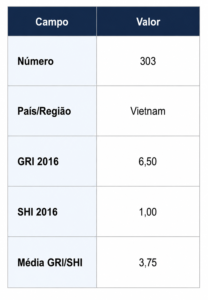
In Vietnam, for example, the greatest obstacle comes from government restrictions. (For comparison, Syria’s GRI is 8.4, while Brazil’s is 2.45.)
Vietnamese society, however, is comparatively tolerant regarding religious freedom. (Syria’s SHI, by contrast, is 9.0.)
This pattern is not universal.
In South Africa, for example, the GRI is only 0.8, while the SHI reaches 3.9, indicating that religious pressure comes primarily from society rather than the government.
The average of the GRI and SHI scores is then statistically normalized to produce the final Oppression Index.
Material Restriction Index
This index reflects the financial limitations faced by missionaries working in a given region, since economic conditions can significantly affect the advancement of the Gospel.
It is based on GDP per capita adjusted for purchasing power parity (PPP) using World Bank data.
The index is calculated using the inverse of GDP per capita: the lower a region’s income level, the higher its material restriction.
Additional statistical adjustments are applied to normalize the data.
Vietnam receives a Material Restriction Index of 0.19.
While relatively low compared with several African countries (for example, 0.70 in the Democratic Republic of the Congo), it is considerably higher than many European countries (such as 0.05 in Hungary).
Missionary Scarcity Index
This index is calculated by dividing the total population of a country or region by the number of Seventh-day Adventists living there.
In other words, it measures the relative scarcity of potential missionaries compared to the size of the population that still needs to hear the Gospel.
Obviously, not every Adventist is actively engaged in missionary work.
Nevertheless, it is reasonable to assume that the proportion of committed believers is broadly similar across different parts of the world.
For that reason, total Adventist membership serves as a useful approximation of missionary capacity.
To illustrate:
If approximately 5% of Adventists are actively living out their missionary calling, then Brazil—with 1.7 million Adventists—could theoretically have around 85,000 active missionaries.
Vietnam, by comparison, has only 13,569 Adventists.
Using the same assumption, that would represent only about 678 active missionaries serving a population of roughly 96 million people.
The significantly greater workload placed upon each missionary is reflected in Vietnam’s Missionary Scarcity Index of 0.72.
By comparison, even the Brazilian state with the highest level of missionary scarcity—Rio de Janeiro—has an index of only 0.25.
Adding Vietnam’s three component scores:
and dividing them by three produces the country’s final EDI score of 0.45, indicating a relatively high level of evangelistic difficulty—certainly much higher than Brazil’s highest regional score, Piauí, at 0.21.
That, in essence, is the EDI. I have no doubt that this is only a first draft and that it will benefit from further refinement. I look forward to receiving thoughtful feedback from fellow believers.
In future articles, I hope to explore what each country’s EDI actually represents, what kinds of conclusions it can—and cannot—support, and how the index might best be used.
Just as importantly, I want to discuss what the EDI does not measure and the situations in which it should not be applied.
I also hope to share several broader observations that emerged while analyzing both the global data and the specific situation in Brazil.
Warm regards,
Lucas.ucas
